
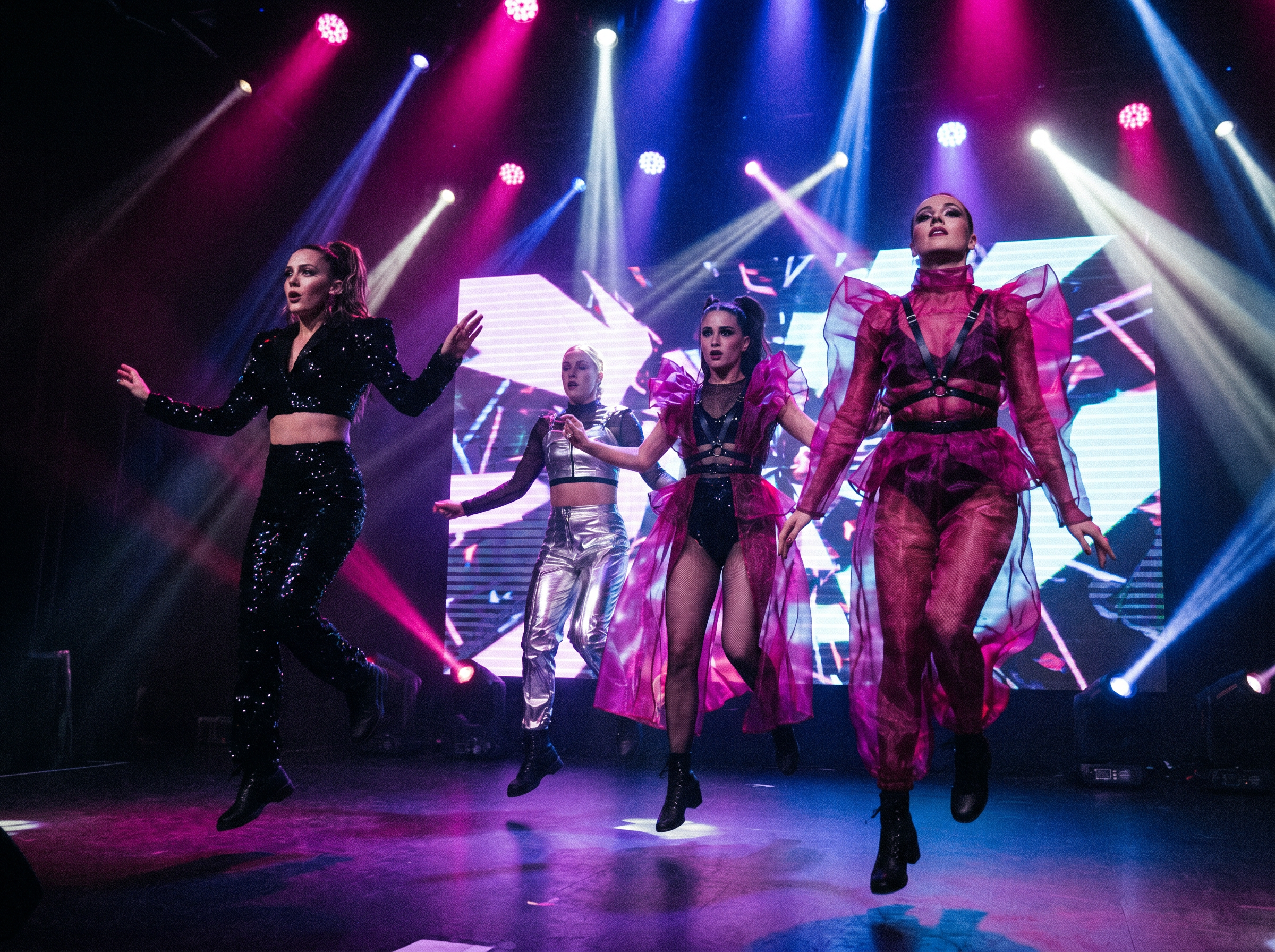
Theatrical pop never really left. It only became embarrassing to admit how much of pop depends on dance-pop/">theatrical-dance-pop/">theater. For a while, the dominant taste online favored the appearance of casualness: the unbothered post, the tossed-off hook, the anti-spectacle spectacle. But pop keeps drifting back toward costume, gesture, era, choreography, and the controlled lie of transformation because those tools do something a plain confession cannot.
Dance-pop is where that return becomes most visible. The body already understands repetition, entrance, climax, and release. Add fashion, lighting, a sharpened persona, and a song starts behaving like a scene rather than a file. The artist is not merely singing about confidence or desire. They are staging it.
Lady Gaga remains the obvious modern reference point because she made theater feel structural, not decorative. The clothes, videos, interviews, performances, and hooks were not separate departments. They created a system of meaning where pop fame itself became material. That legacy is complicated because many artists learned the surface lesson and missed the discipline underneath. Outrage alone is not theater. A strange outfit without a point is just luggage.
Rina Sawayama’s work is often compelling because it understands theatricality as a way to hold contradiction. She can move between rock weight, pop gloss, family narrative, and fashion-forward staging without pretending those registers cancel one another. Dorian Electra pushes further into exaggeration, turning gendered performance, internet camp, and pop construction into something deliberately unstable. Kim Petras often treats pop as high-gloss fantasy machinery. Kylie Minogue, across decades, has shown how elegance and dance-floor function can become a kind of soft theater: less confrontational, but no less constructed.
What has changed is the audience’s literacy. Listeners now read eras almost instantly. They notice the font, the palette, the rollout, the haircut, the choreography, the cover image, the micro-genre cue, the mood board leaking through the single art. That can make pop more exciting, but also more exhausting. Every artist is expected to be a world-builder, even when the songs only need to be songs.
Theatrical dance-pop works best when the performance pressure is audible. A persona should create friction. It should make the vocal choose a posture. It should give the production a room to inhabit. When theater is only pasted onto a track after the fact, the result feels like a costume party held in a conference room.
There is a reason club energy and theatricality pair so naturally. A club already invites transformation. People arrive dressed as slightly edited versions of themselves. They practice eye contact. They exaggerate indifference. They become louder, colder, softer, funnier, more beautiful, more reckless. The dance floor is not honest in a documentary sense, but it can be emotionally accurate in a symbolic one.
Modern theatrical dance-pop often borrows from this social grammar. The best songs understand how people perform themselves when they want to be desired but not understood too quickly. The bass line becomes posture. The chorus becomes lighting. The bridge becomes a crack in the makeup.
There is a danger in mistaking maximalism for substance. Some recent pop eras have treated “world-building” as a shopping list: latex, chrome, nightclub, religious image, glitch type, blood-red lighting, a few slogans about fame. The pieces can look impressive and still feel dead. Real theatricality needs stakes. Something about the performance has to cost the artist or character something, even if that cost is stylized.
Kylie’s longevity offers a quieter lesson. Reinvention does not always require violent rupture. Sometimes theater is refinement: knowing the exact amount of shimmer a song needs, the exact point where a disco reference becomes alive rather than retro cosplay. Her dance-pop often trusts pleasure without flattening it into stupidity.
Gaga’s lesson is different. She proved that an artist could make pop spectacle self-aware without draining it of feeling. At her best, the artifice intensified the emotion. That remains the bar. Pop can be artificial and sincere at the same time, but only when the artificiality is doing emotional work.
Rina and Dorian show how theatrical pop can now carry identity discourse without becoming a lecture. Their work often knows that the self is not a stable object waiting to be revealed. It is built, revised, performed, defended, exaggerated, and sometimes parodied. That idea fits dance music because dance music is already about temporary states.
The internet has made this both easier and worse. Easier because artists can distribute visual codes directly. Worse because those codes are immediately flattened into content. A look becomes a meme before the song has time to breathe. A performance becomes an aesthetic category before anyone asks what it is performing.
For smaller artists, theatricality can be a survival tool. It offers shape in a crowded field. But it can also become a trap if the image outruns the writing. A strong persona might get someone to click once. It will not make them return if the songs have no pulse.
The return of theatrical dance-pop is therefore not just a revival of drama. It is a test of discipline. The artists who matter will be the ones who know when to make the room bigger and when to turn one light on a face and let the mask slip.
What matters is not whether every artist involved sounds alike. They do not, and forcing them into one tidy movement would flatten the point. The shared signal is more atmospheric than technical: a willingness to let pop carry tension, to let image behave like structure, and to let the dance floor act as a stage for complicated feeling rather than simple escape.
That is why the best writing around this music has to resist the easy headline. A song can be fun and defensive at once. A visual era can be beautiful and slightly suspect. A club track can be engineered for release while still carrying a private bruise. Fever Signal is most interested in that overlap, where style is not decoration but evidence.
The healthier future for this lane will depend on restraint. The internet rewards constant escalation: brighter visuals, harder hooks, bigger claims, more mythology, faster reinvention. Some artists will burn out trying to turn every release into an event. The better work tends to make its own weather slowly, giving listeners enough surface to enter and enough shadow to return.
For a small publication, that restraint matters as much as the subject matter. Fever Signal is not trying to crown a scene before it exists, or pretend every stylish release is a cultural rupture. The more useful task is slower: notice patterns, name pressures, separate mood from substance, and give emerging work enough context without inflating it into mythology. Underground pop deserves writing that can enjoy the lighting without being fooled by it.
That also means leaving room for failure. Not every glossy hook earns its drama. Not every visual era deserves the word “world.” Not every artist with a coherent palette has a coherent point of view. The current moment is exciting because the tools for self-construction are everywhere, but that abundance also makes imitation easier. The strongest work usually contains some resistance to its own aesthetic, a detail that feels inconvenient, funny, wounded, plain, or too specific to have been generated by trend alone.
The listener’s job is not to police pleasure until it dies. A great pop song can be immediate, silly, expensive-sounding, emotionally obvious, or built for one perfect walk to the train. But criticism can ask whether the pleasure has texture. Does the track leave a residue after the first rush? Does the image reveal a person, a character, a scene, or only a reference board? Does the performance understand what it is protecting? Those questions keep the conversation alive after the chorus ends.
Fever Signal’s interest in nightlife-pop, alt-pop, dark dance-pop, and visual culture starts there: in the gap between surface and signal. The surface matters. The signal matters more.
A useful archive should age better than a rollout. It should still make sense when the teaser clips are gone, when the palette changes, and when the artist has moved to another room. That is the standard here: not hype that expires by next week, but criticism that helps the reader understand why a sound, image, or pose felt charged in the first place.
The music after midnight is rarely pure. It is commercial and private, theatrical and practical, funny and wounded, sometimes brilliant and sometimes just dressed well. Writing about it honestly means keeping all of those truths in the frame at once, even when the cleaner story would be easier to sell. That friction is the point of the whole signal, and always has been. The most convincing version of this editorial frame is patient rather than breathless. It lets a song be minor without treating that as failure, and lets a small artist be promising without pretending promise is proof. That distinction is what keeps a niche publication credible. Taste is not the same as hype; taste is the ability to hear scale, limits, texture, and possibility at the same time. It also remembers that restraint can be more persuasive than volume, especially in a culture trained to mistake loudness for arrival and saturation for meaning. The archive should feel edited, not inflated, and skeptical without becoming allergic to pleasure, because pleasure is part of the evidence too, not a guilty exception to it at all.